
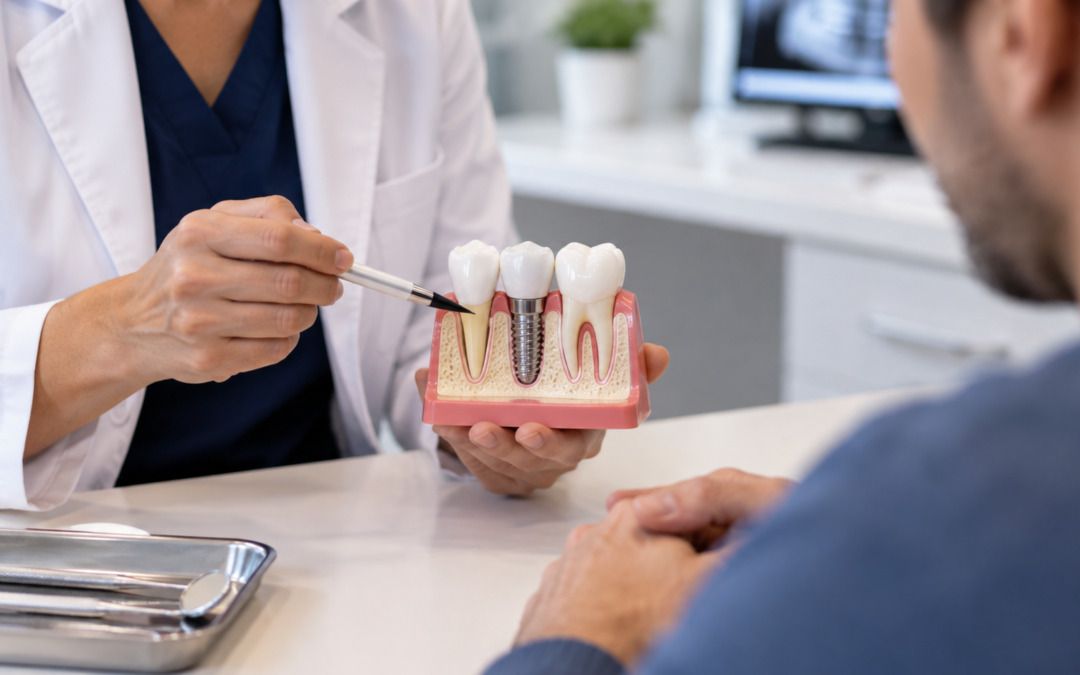
When most people hear “dental implant,” they picture a single titanium post replacing a missing tooth. But dental implants are not one-size-fits-all. There are several types of dental implants, and the right one for you depends on factors like your bone health, how many teeth you are missing, and your overall oral health.
This guide breaks down every type of dental implant available today, from the most common to the most specialized, so you can walk into your consultation informed and confident. Whether you are missing one tooth or an entire arch, understanding your options is the first step toward making the right decision.
The 3 Main Types of Dental Implants
The most fundamental way to categorize dental implants is by placement, meaning where and how the implant is anchored in your jaw. There are three main types, and each one is designed for a different bone condition.
1. Endosteal Implants
Endosteal implants are the most common type of dental implant used today. The word “endosteal” means “within the bone,” which describes exactly how they work. A small titanium post is surgically placed directly into the jawbone, where it acts as an artificial tooth root.
Over the following three to six months, the implant undergoes osseointegration, a natural process in which the surrounding bone tissue fuses with the titanium post. This fusion creates an exceptionally strong and stable foundation. Once osseointegration is complete, an abutment and a custom crown are attached on top to complete the restoration.
Endosteal implants are the right choice for most patients. The ideal candidate has a healthy jawbone with enough density and height to support the implant. They offer the highest long-term success rates of any implant type, typically above 95% over 10 years, and provide the most natural look and feel of all the options available.
2. Subperiosteal Implants
Subperiosteal implants take a different approach. Instead of being placed inside the jawbone, they sit on top of the bone but beneath the gum tissue. A custom metal framework is fitted to the contour of the patient’s jawbone, and small posts extend through the gums to hold the replacement teeth in place.
This type of implant was developed for patients who do not have enough bone density or height to support a traditional endosteal implant and who either cannot undergo a bone grafting procedure or prefer to avoid one.
Subperiosteal implants are significantly less common today than they were in previous decades. Modern bone grafting techniques have made it possible for many patients who would previously have needed a subperiosteal implant to qualify for the more reliable endosteal option instead. However, subperiosteal implants remain a viable solution for specific cases where bone grafting is not a feasible path.
3. Zygomatic Implants
Zygomatic implants are the least common of the three main types and are reserved for patients with severe bone loss in the upper jaw. Rather than anchoring into the jawbone, zygomatic implants are placed in the zygomatic bone, which is the cheekbone.
These implants are significantly longer than standard implants and bypass the upper jaw entirely. This makes them an option for patients who have experienced extensive bone loss in the upper jaw and cannot support conventional implants even with grafting procedures.
Zygomatic implants are a highly specialized procedure, offered by a limited number of trained providers. They are not a routine treatment option and are typically considered only when all other implant approaches are not feasible due to the severity of bone loss present.
Types of Dental Implants by How Many Teeth You’re Replacing
Beyond placement, dental implants also differ by how many teeth they are designed to support. The right solution depends on whether you are missing one tooth, a few adjacent teeth, or an entire arch.
Single Tooth Implant
A single tooth implant is exactly what it sounds like: one implant post topped with one custom dental crown. It is the most straightforward implant option and the best choice when you are missing one individual tooth.
What makes single tooth implants stand out is that they are completely independent. The implant does not rely on or affect the teeth on either side of the gap. Adjacent teeth stay untouched, the jawbone underneath is preserved, and the result looks and functions exactly like a natural tooth. For a single missing tooth with healthy surrounding bone, this is almost always the recommended solution.
Implant-Supported Bridge
When two or more adjacent teeth are missing, an implant-supported bridge is a highly effective option. Instead of placing an individual implant for every missing tooth, two implants are placed at either end of the gap and a bridge is anchored across them.
This approach is far more stable than a traditional dental bridge, which relies on grinding down healthy neighboring teeth for support. With an implant-supported bridge, the natural teeth on either side are left completely intact, and the jawbone beneath the gap continues to receive stimulation, slowing bone loss over time.
All-on-4 Dental Implants
All-on-4 is one of the most transformative implant solutions available for patients who are missing most or all of their teeth in a single arch. As the name suggests, an entire arch of replacement teeth is supported by just four strategically placed implants.
Two implants are positioned vertically at the front of the jaw, and two are angled toward the back to maximize contact with available bone. This angled placement is key because it often eliminates the need for bone grafting, even in patients who have experienced some degree of bone loss.
All-on-4 is also known for its efficiency. In many cases, a temporary full arch restoration can be placed on the same day as the implant surgery, meaning patients leave the office with a functional smile. At Woodbridge Comfort Dental Care, we offer All-on-4 as part of our implant services, with free consultations to determine whether you are a candidate.
Full Mouth Dental Implants and Implant-Supported Dentures
For patients who need complete restoration of both arches, full mouth dental implants provide a permanent, fixed solution. This can be achieved through an All-on-6 approach, which uses six implants per arch for greater stability and load distribution, or through implant-supported dentures.
Implant-supported dentures differ from traditional dentures in one important way: they are anchored to implants in the jawbone rather than resting loosely on the gum tissue. This eliminates the slipping, discomfort, and dietary restrictions that come with conventional dentures. They can be fixed, meaning only a dentist can remove them, or removable, meaning the patient takes them out for cleaning.
For patients considering a full transformation, our full mouth reconstruction service combines advanced diagnostics with personalized treatment planning to restore function and confidence from the ground up.
What About Mini Dental Implants?
Mini dental implants are a smaller version of the standard endosteal implant. While a traditional implant post measures between 3.5 and 5 millimeters in diameter, mini implants are less than 3 millimeters, roughly the width of a toothpick.
Because of their smaller size, mini implants require less bone volume and involve a less invasive procedure. In many cases they can be placed with minimal or no incisions, which means a faster and more comfortable recovery.
They are most commonly used to stabilize lower dentures. Patients who struggle with slipping, discomfort while eating, or gumline irritation often find that a small number of mini implants snap the denture securely into place, dramatically improving comfort without the cost or complexity of a full implant-supported restoration.
Mini implants can also work for replacing small teeth in areas with limited bone width, such as lower front teeth, or as a transitional solution while working toward a more permanent restoration.
That said, they are not designed for heavy chewing forces and are generally not recommended for single crown restorations in the back of the mouth. They also carry less long-term clinical data than traditional endosteal implants.
A proper evaluation, including a review of your bone volume and treatment goals, is the best way to determine whether mini implants are the right fit for you.
Which Type of Dental Implant Is Right for You?
Choosing the right type of dental implant is not a decision you need to make on your own. That said, understanding how different patient situations typically map to different solutions can help you walk into your consultation with a clearer picture of what to expect.
Here is a straightforward breakdown based on the most common scenarios:
Missing one tooth with healthy bone. A single endosteal implant with a custom crown is almost always the best option. It is the most natural, most durable, and most conservative solution available for a single missing tooth.
Missing several adjacent teeth. An implant-supported bridge is typically the most efficient approach. Two implants anchor a fixed bridge across the gap, preserving the surrounding teeth and the bone beneath.
Missing most or all teeth in one arch. All-on-4 is worth exploring as a first option. It restores an entire arch with four implants, often without the need for bone grafting, and can frequently be completed with a same-day temporary restoration.
Missing all teeth in both arches. Full mouth dental implants, whether through an All-on-6 approach or implant-supported dentures, provide a complete and permanent solution. The right configuration depends on your bone levels and your goals.
Bone loss present. Depending on the degree of bone loss, a bone grafting procedure followed by standard endosteal implants may be recommended. In more advanced cases of upper jaw bone loss, zygomatic implants or subperiosteal implants may be considered.
The most important factor in all of these decisions is an accurate assessment of your jawbone. At Woodbridge Comfort Dental Care, every implant consultation includes a thorough evaluation and CBCT imaging when needed, so your treatment plan is built around your specific anatomy, not a generic protocol. To learn more or get started, visit our dental implants in Woodbridge, VA page.