
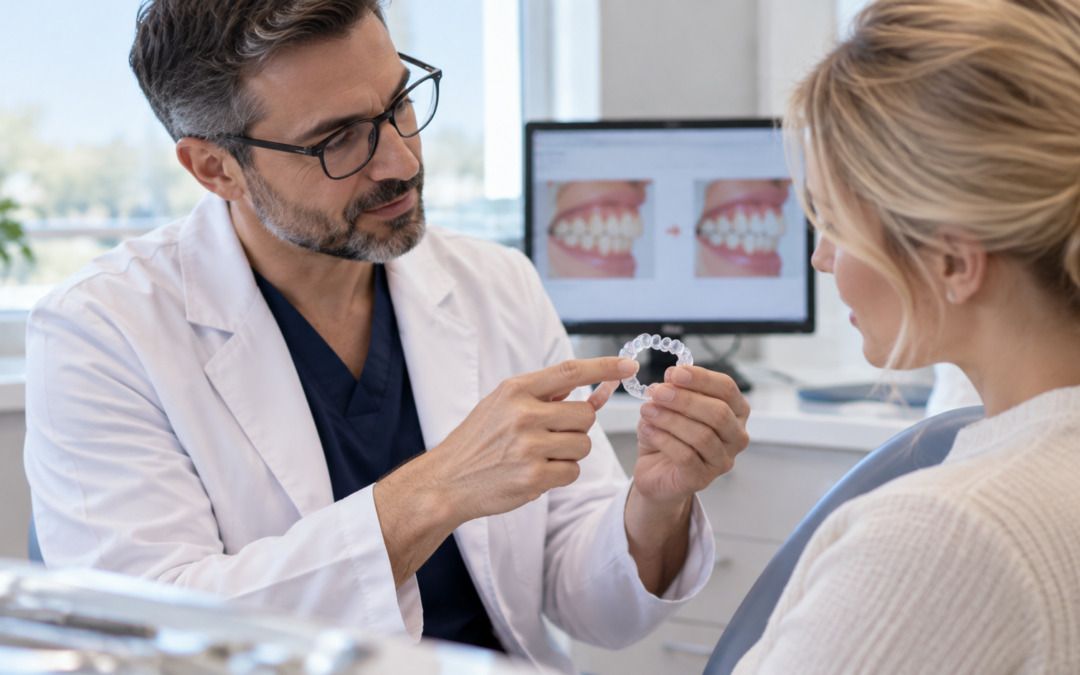
If you have been told you have an overbite, or you have noticed that your upper front teeth overlap your lower front teeth more than expected, you may be wondering whether Invisalign can fix it.
The short answer is yes, in many cases. Invisalign can effectively correct many mild to moderate dental overbites, but treatment depends on the cause and severity of the bite.
This guide explains how Invisalign fixes overbites, what factors affect treatment, and what you can expect if you are considering clear aligners.
What Is an Overbite?
An overbite describes the vertical overlap of the upper front teeth over the lower front teeth. A small amount of overlap is normal. The concern is when the upper teeth cover too much of the lower teeth, which is sometimes referred to as a deep bite.
An excessive overbite can be more than a cosmetic concern. Depending on its severity, it may contribute to uneven tooth wear, discomfort when chewing, gum problems, or jaw pain. Cleveland Clinic notes that treatment depends on several factors, including the severity of the overbite and the patient’s age.
Overbite vs. overjet
Overbite and overjet are often confused, but they describe different bite problems.
An overbite is a vertical problem: the upper front teeth overlap the lower front teeth more than they should.
An overjet is a horizontal problem: the upper front teeth project too far in front of the lower front teeth.
This distinction matters because the cause and direction of the bite problem influence how it should be treated.
Does Invisalign Fix Overbites?
Yes. Invisalign can be an effective treatment for many mild to moderate dental overbites.
Clear aligners use a series of customized trays to gradually move teeth according to a planned sequence. For overbite correction, treatment may involve repositioning the front teeth, changing the vertical position of certain teeth, or improving how the upper and lower teeth meet.
Depending on the case, Invisalign treatment can also incorporate features such as bite ramps, tooth-colored attachments, or elastics to create additional control over tooth movement.
Treatment is planned digitally before it begins. At Woodbridge Comfort Dental Care, iTero scanning technology is used to capture a detailed digital model of the teeth, plan treatment, and provide a preview of how the smile may change.
Whether Invisalign can correct an overbite depends largely on what is causing it.
Single Tooth Implant
A single tooth implant is exactly what it sounds like: one implant post topped with one custom dental crown. It is the most straightforward implant option and the best choice when you are missing one individual tooth.
What makes single tooth implants stand out is that they are completely independent. The implant does not rely on or affect the teeth on either side of the gap. Adjacent teeth stay untouched, the jawbone underneath is preserved, and the result looks and functions exactly like a natural tooth. For a single missing tooth with healthy surrounding bone, this is almost always the recommended solution.
Dental overbite
A dental overbite is primarily related to the position of the teeth.
For example, the front teeth may be positioned in a way that creates excessive vertical overlap even when the underlying relationship between the jaws is relatively normal.
These cases may be well suited to clear aligner treatment because correction mainly depends on controlled tooth movement.
Skeletal overbite
A skeletal overbite involves the relationship or development of the upper and lower jaws.
In these cases, moving the teeth alone may not completely address the underlying problem.
Depending on the severity of the jaw discrepancy, treatment may involve other orthodontic approaches or, in some severe adult cases, corrective jaw surgery.
A 2025 systematic review found that clear aligners can effectively correct mild to moderate dentoalveolar deep bites. However, the evidence for skeletal cases was less certain, and some patients required refinements to achieve the planned correction.
This is why an examination is important before assuming that every overbite can be treated in the same way.
How Does Invisalign Fix an Overbite?
Invisalign uses a series of custom clear aligners to apply controlled forces to the teeth.
Rather than trying to move every tooth at once, each aligner makes small changes according to the treatment plan. Over time, these movements can reduce excessive overlap and improve the way the upper and lower teeth fit together.
Depending on your bite, treatment may use several different techniques.
Attachments are small, tooth-colored shapes bonded to selected teeth. They give the aligners additional grip and help create movements that may be difficult to achieve with the aligners alone.
Bite ramps may be incorporated into certain aligners to help manage a deep bite by changing how the teeth contact during treatment.
Elastics, sometimes called rubber bands, may also be used when additional force is needed to improve the relationship between the upper and lower teeth.
Not everyone with an overbite needs these additional features. Your treatment plan depends on the type of overbite and the movements required to correct it.
Can Invisalign Fix a Severe Overbite?
Invisalign can treat many mild to moderate overbites. Severe cases require a more detailed evaluation.
If a severe overbite is primarily caused by tooth position, clear aligners may still be an option in some cases. If the problem is strongly related to jaw structure, Invisalign alone may not provide the correction needed.
More complex cases may require traditional braces, additional orthodontic treatment, or, in some severe skeletal cases, corrective jaw surgery.
Many adults with mild to moderate dental overbites may be candidates for Invisalign, but the type and severity of the bite need to be assessed first.
A clinical evaluation can determine whether Invisalign is likely to correct the overbite adequately or whether another treatment approach would provide a more predictable result.
Does Invisalign Fix Overbites Without Rubber Bands?
Sometimes.
For certain dental overbites, aligners, attachments, and bite ramps may be enough to create the necessary tooth movements without elastics.
Other cases may benefit from rubber bands. Elastics connect the upper and lower arches and provide additional force to help improve the bite relationship.
If elastics are included in your treatment plan, it is important to wear them according to your provider’s instructions. They are part of the planned orthodontic forces needed to keep treatment progressing as intended.
Whether you need rubber bands cannot be determined simply by how noticeable your overbite looks. It depends on the underlying bite relationship and the movements needed to correct it.
Can Invisalign Fix an Overbite in Adults?
Yes. Many adults can be good candidates for Invisalign overbite treatment.
While certain jaw-related bite problems are easier to influence while a child or teenager is still growing, adults can still benefit from orthodontic tooth movement.
For adults, candidacy depends on factors such as:
- The type and severity of the overbite
- The health of the teeth and gums
- Whether the problem is primarily dental or skeletal
- The amount of tooth movement required
- The ability to wear the aligners consistently
Invisalign aligners are generally recommended for 20 to 22 hours per day, removing them mainly for eating, drinking anything other than water, brushing, and flossing.
Age alone does not determine whether Invisalign will work. A complete bite evaluation provides a much clearer answer.
How Long Does Invisalign Take to Fix an Overbite?
There is no single Invisalign timeline for every overbite.
At Woodbridge Comfort Dental Care, most Invisalign treatments take around 12 to 18 months, although minor cases may finish sooner and more complex cases can take longer.
For overbite correction specifically, treatment time can be affected by:
- The severity of the overbite
- Whether the problem is primarily dental or skeletal
- The amount and type of tooth movement required
- Whether attachments or elastics are needed
- Whether crowding, spacing, or other alignment issues also need correction
- How consistently the aligners are worn
- Whether refinements are needed during treatment
Following the recommended wear schedule helps keep tooth movement progressing according to the treatment plan.
Your individual timeline can be estimated more accurately after your teeth and bite have been evaluated.
Invisalign vs. Braces for Overbite Correction
Both Invisalign and traditional braces can be used to correct overbites. The better choice depends on the type of bite problem and the movements needed to correct it.
Invisalign may be a suitable option when the overbite is mild to moderate and primarily dental in origin. It also appeals to patients who prefer a removable and less noticeable orthodontic treatment.
Because Invisalign aligners are removable, patients can take them out when eating and for brushing and flossing. However, that flexibility also means treatment depends on consistently wearing the aligners as instructed.
Traditional braces remain an effective option and may be recommended when more complex tooth movement or bite correction is required. Because braces remain fixed to the teeth, they do not depend on the patient remembering to wear an appliance throughout the day.
Neither option is automatically better for every overbite. The most appropriate treatment is the one that can predictably achieve the movements your individual bite requires.
How to Know If Invisalign Can Fix Your Overbite
You cannot reliably determine whether Invisalign will correct your overbite simply by looking in the mirror.
An evaluation looks at the entire bite, including:
- How much the upper teeth overlap the lower teeth
- The position of the upper and lower teeth
- The relationship between the jaws
- Any crowding or spacing
- The health of the teeth and gums
- The movements required to create a stable bite
At Woodbridge Comfort Dental Care, Invisalign treatment is led by Dr. Patrick Lotfi, a certified Invisalign provider who trained at Invisalign’s corporate headquarters. He uses iTero digital scanning technology to evaluate the teeth, plan treatment, and show patients a digital preview of how their smile may change.
If improving your bite is part of a broader smile enhancement plan, Woodbridge Comfort Dental Care also provides cosmetic dentistry in Woodbridge, with treatment options tailored to your individual goals.
This reads more naturally and avoids repeating “including Invisalign” immediately after an entire Invisalign-focused section.
Book a Free Invisalign Consultation in Woodbridge, VA
If you have an overbite and want to know whether clear aligners are appropriate for your case, an evaluation is the best place to start.
Woodbridge Comfort Dental Care offers complimentary consultations for patients considering Invisalign in Woodbridge. Dr. Lotfi can evaluate your teeth, bite, and alignment, explain what treatment may involve, and provide a personalized treatment timeline.
Call (703) 580-8181 or book online to schedule your consultation. The practice confirms that complimentary Invisalign consultations are available and that typical treatment timelines vary according to case complexity.